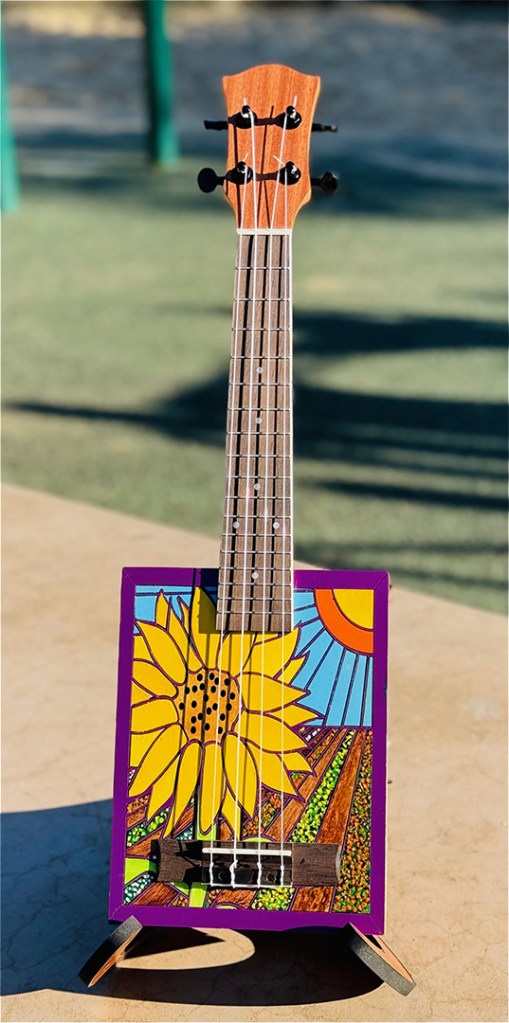
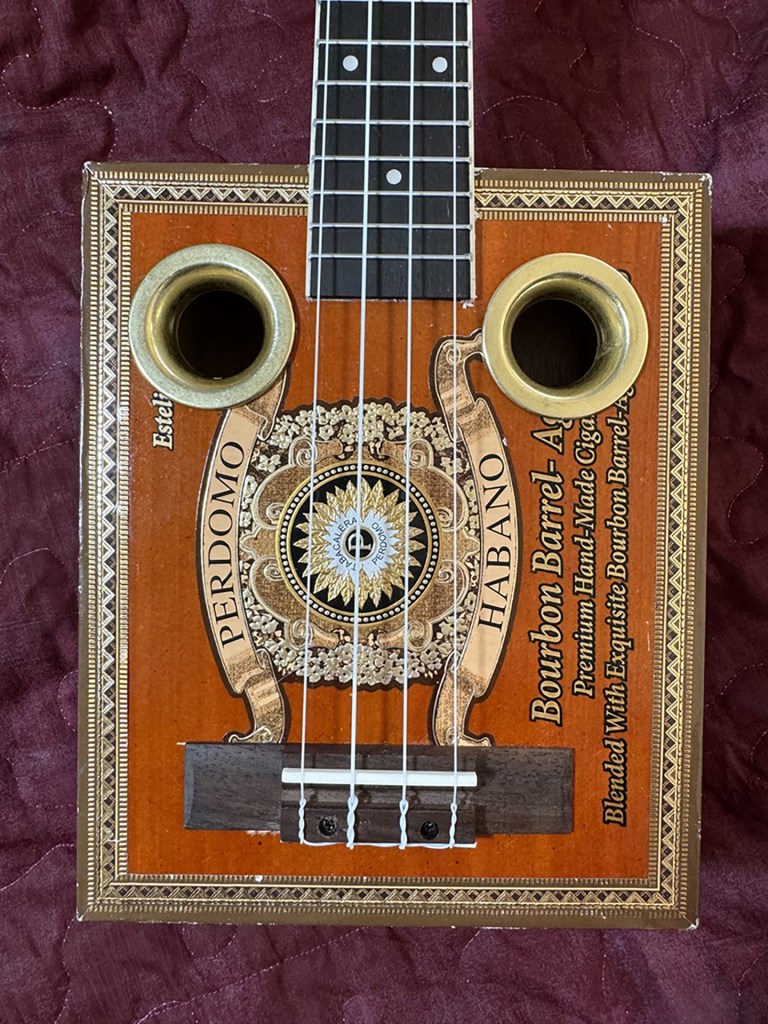
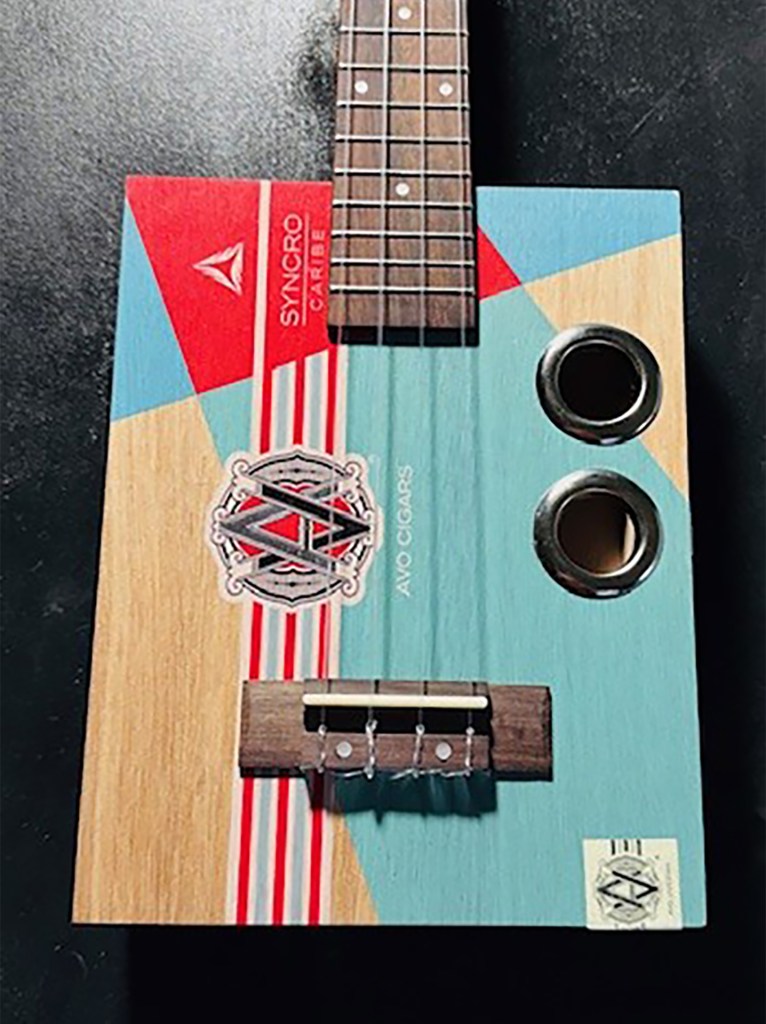
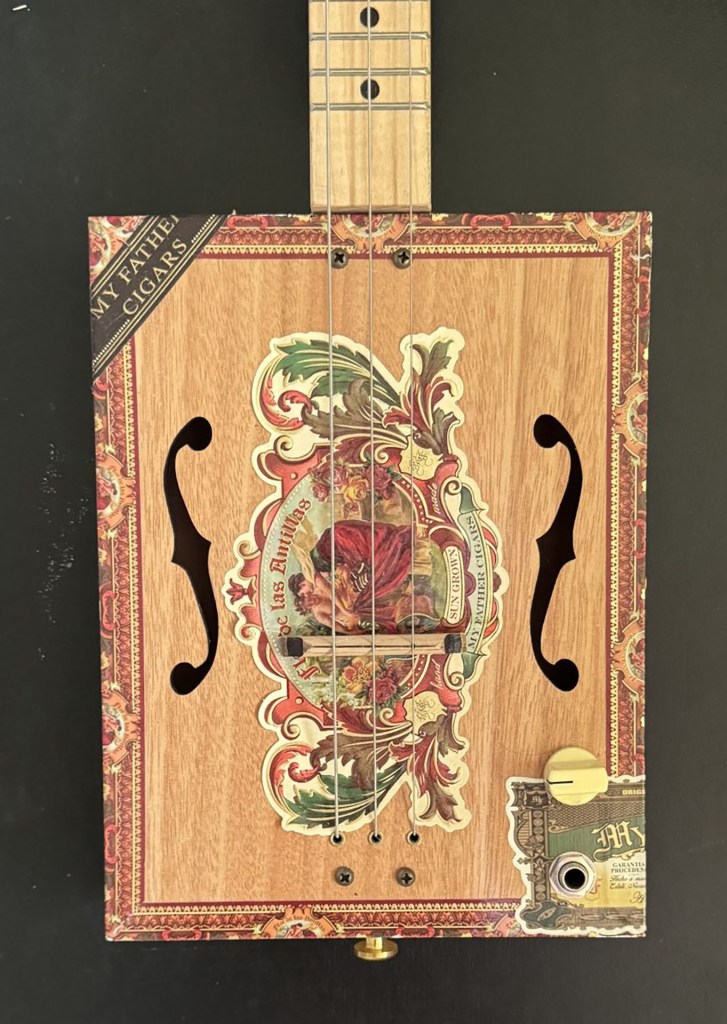
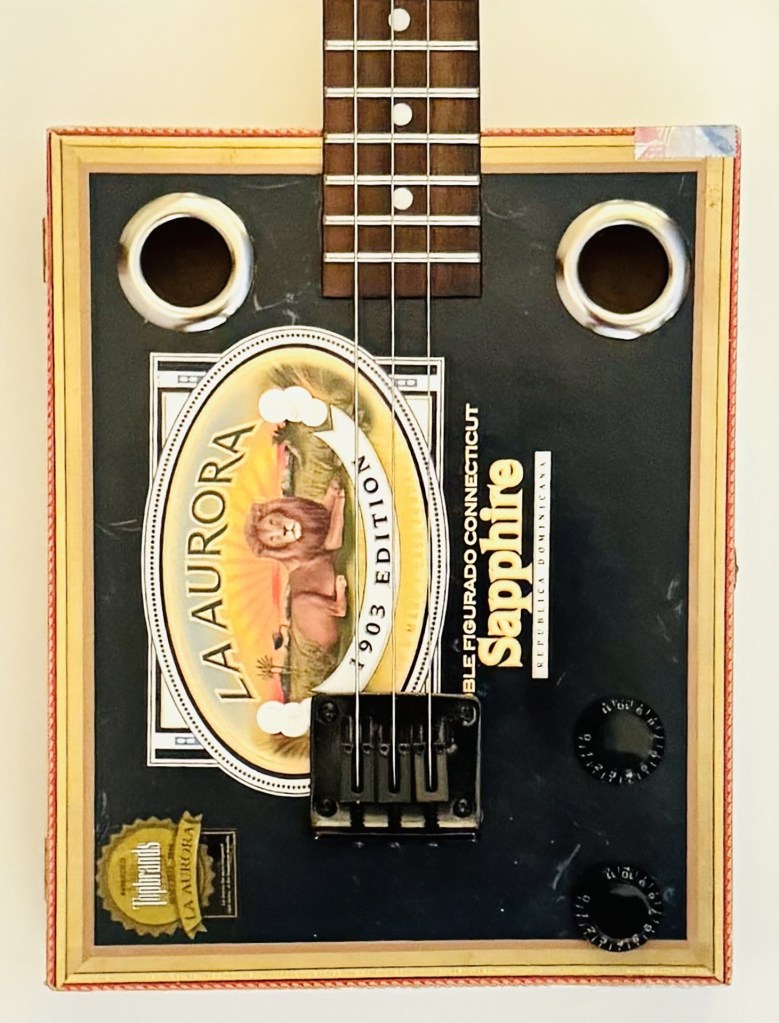
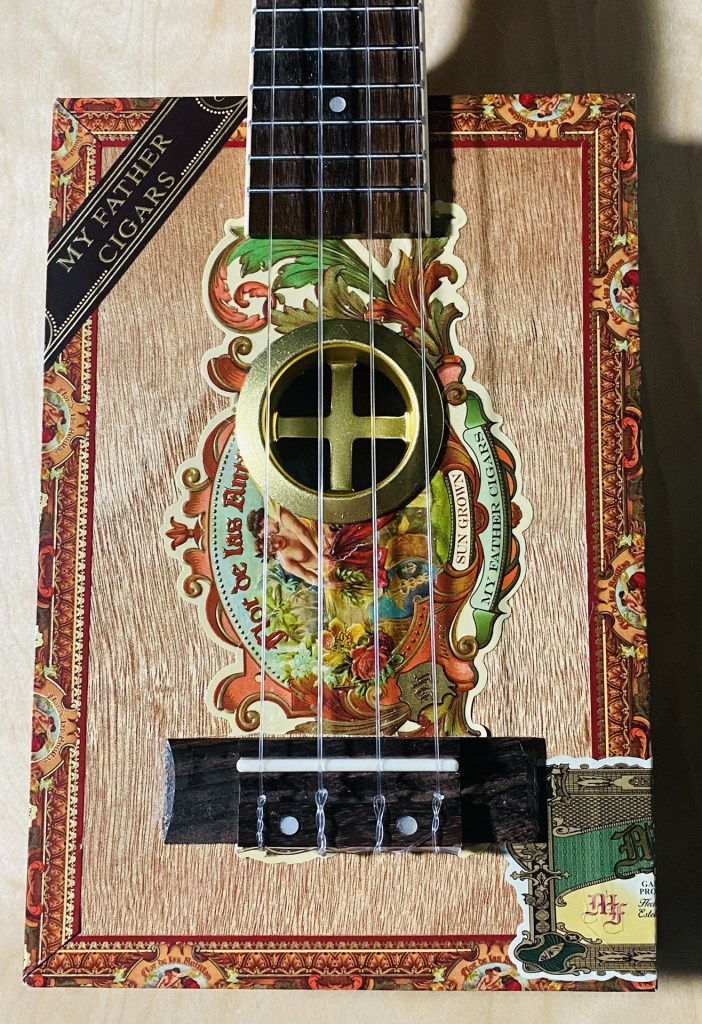
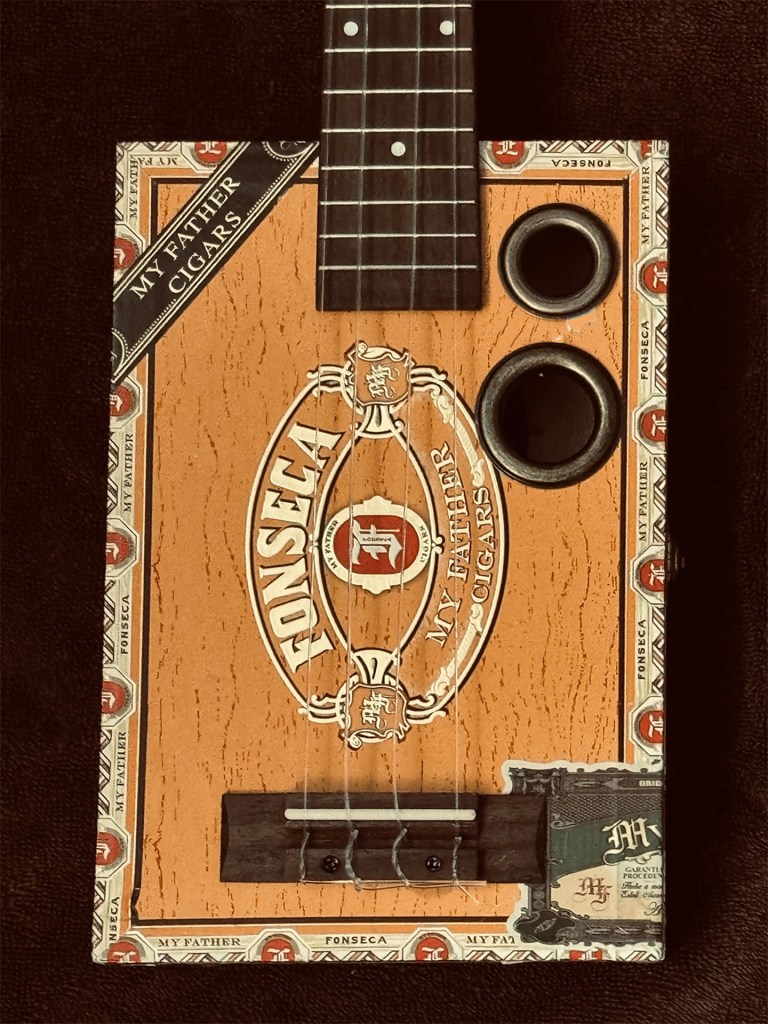
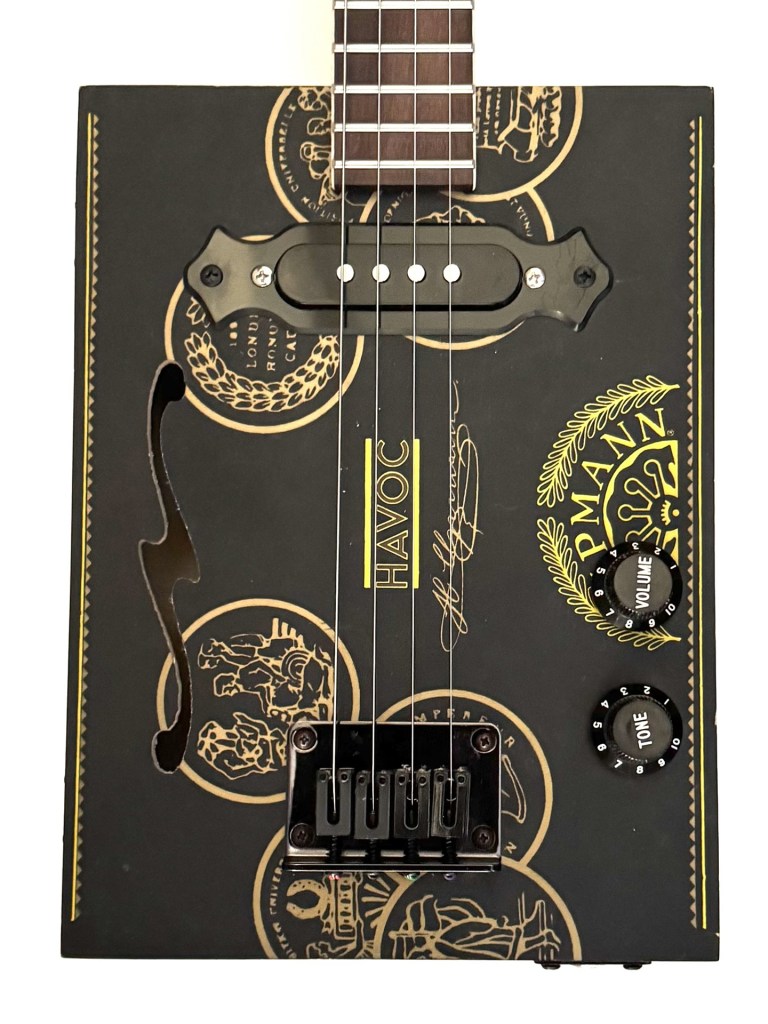
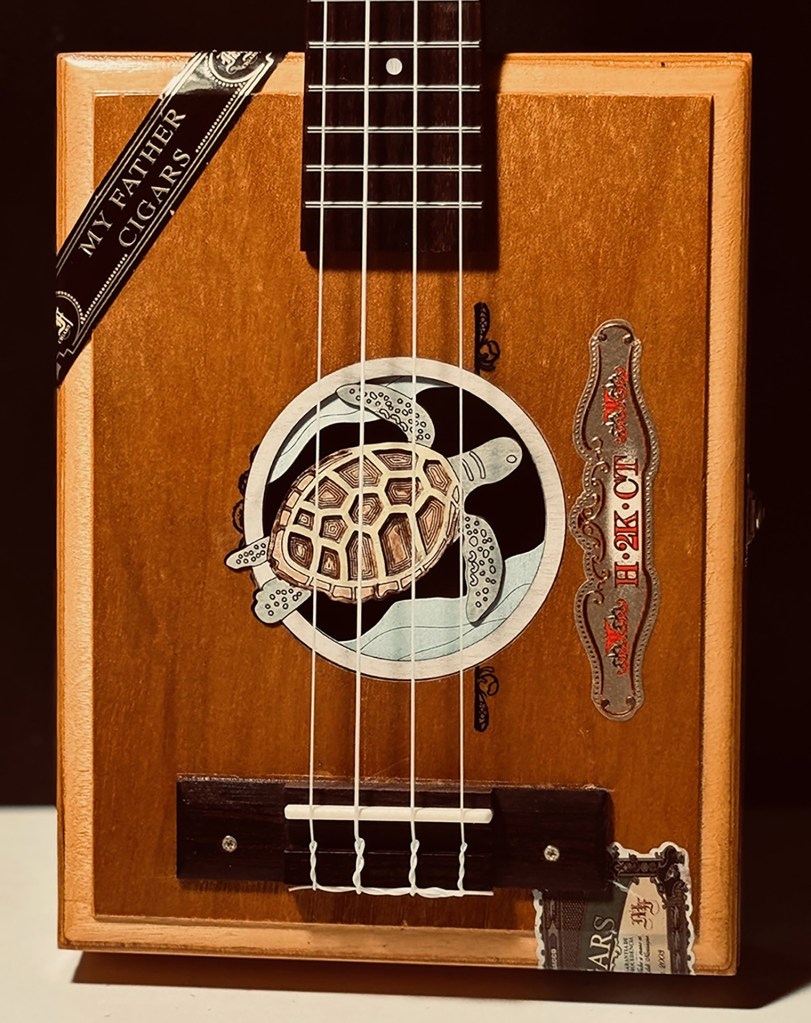
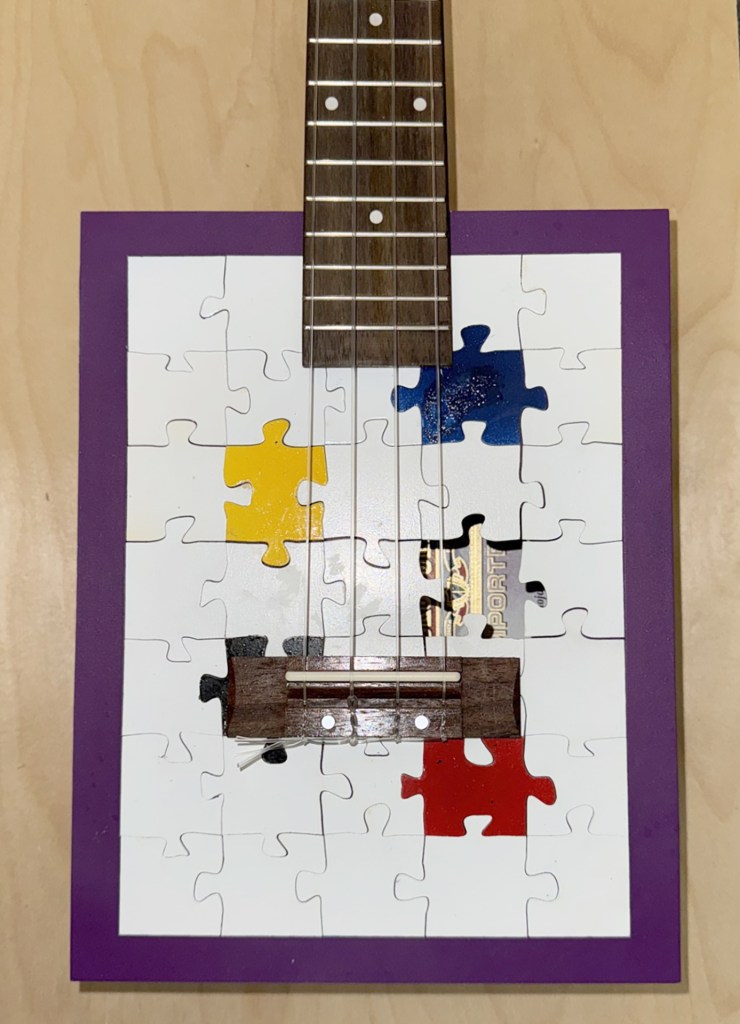
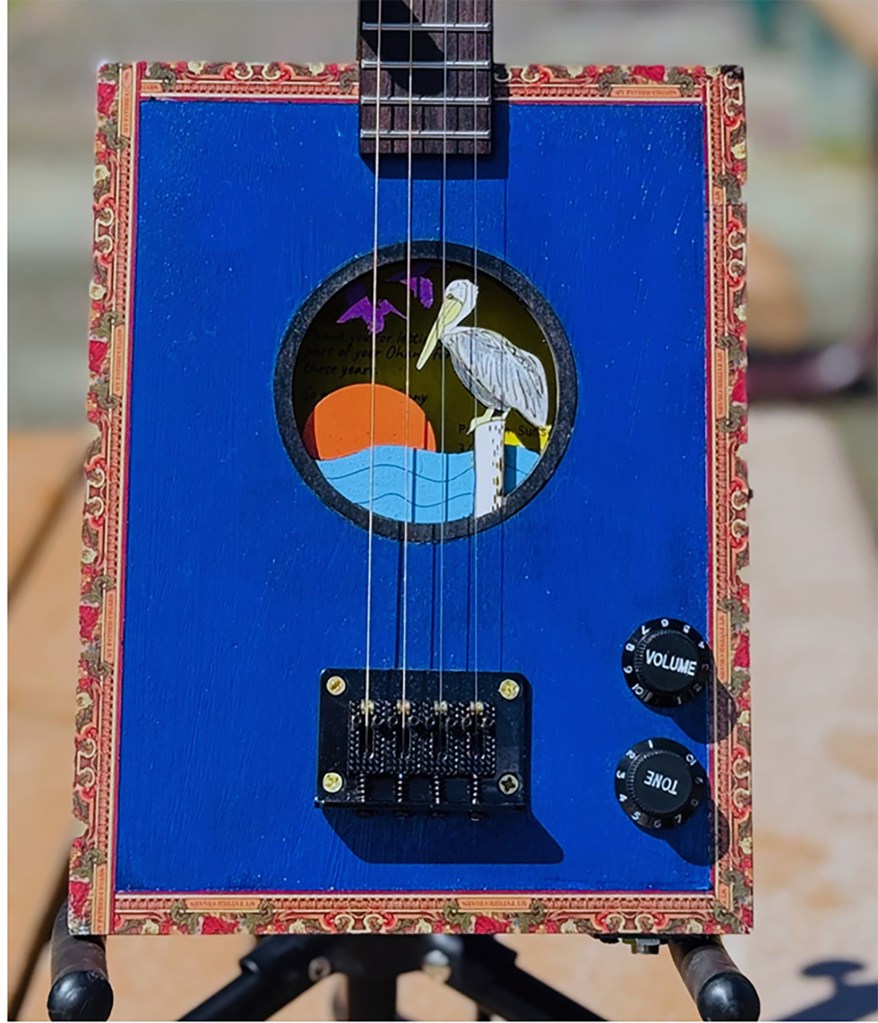
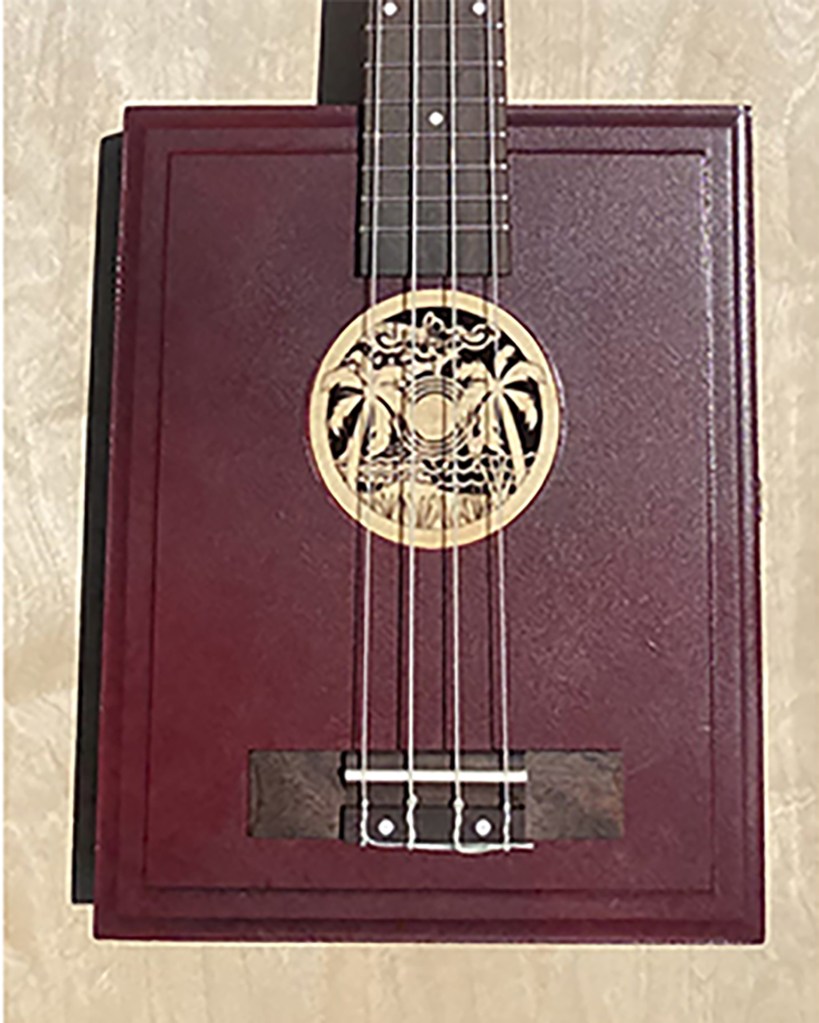
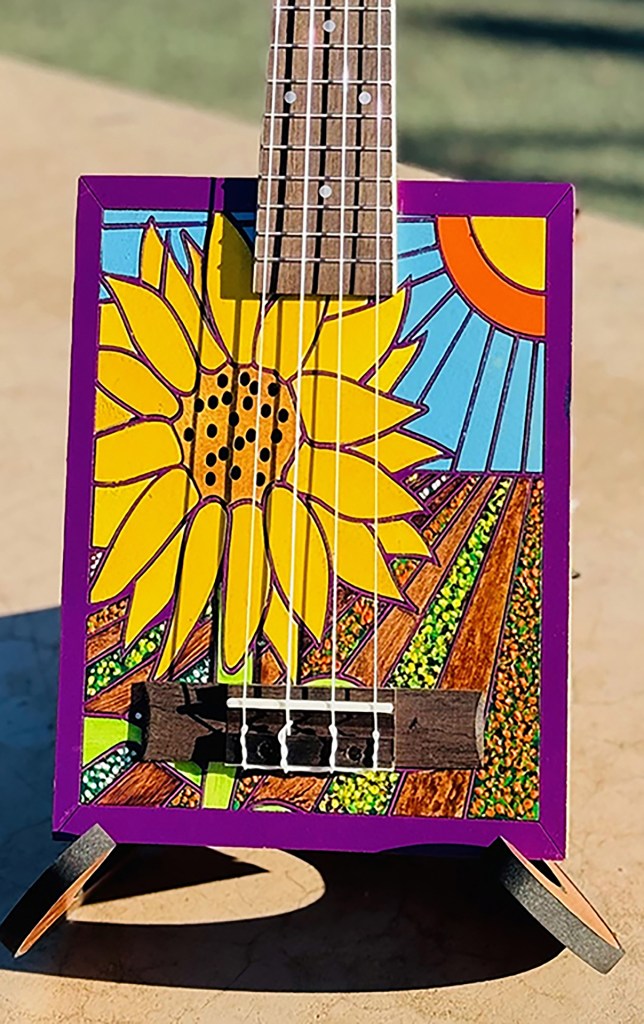
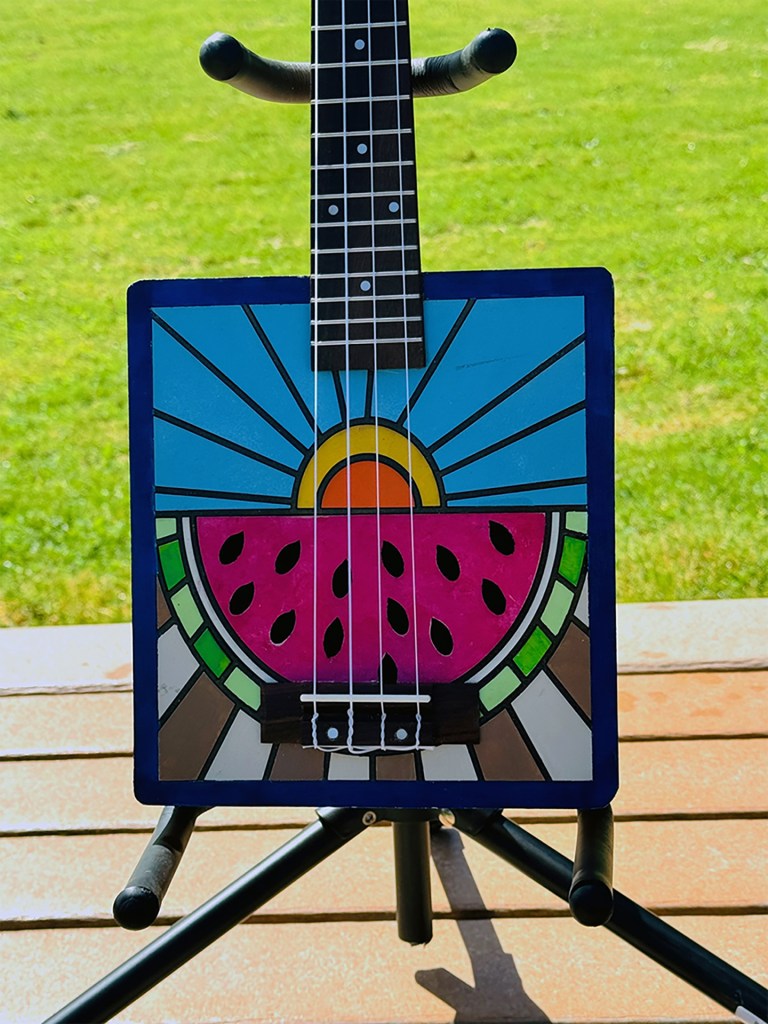
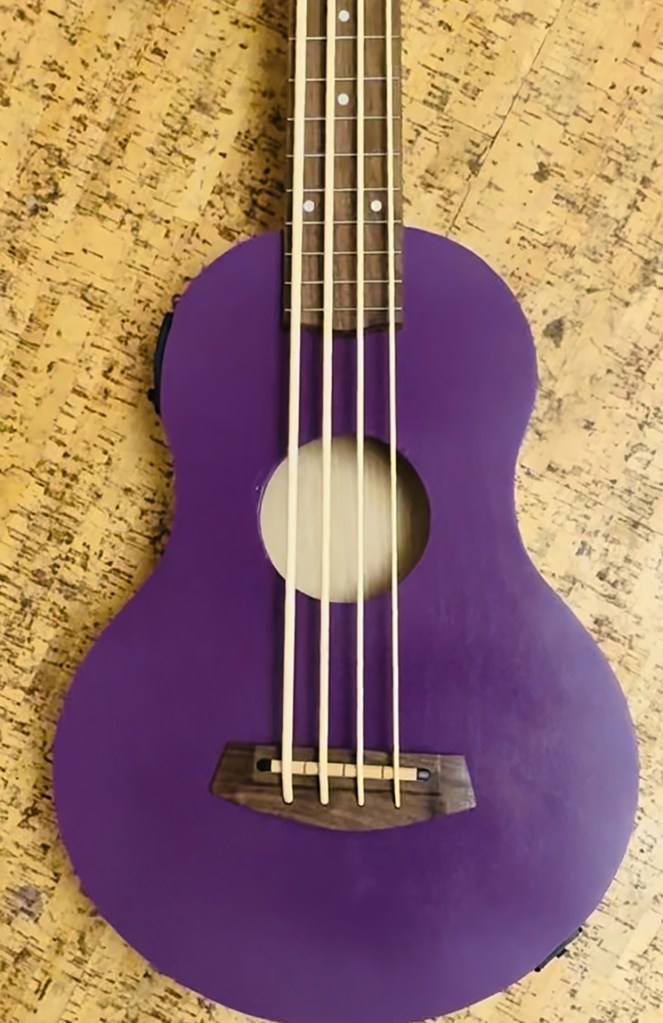
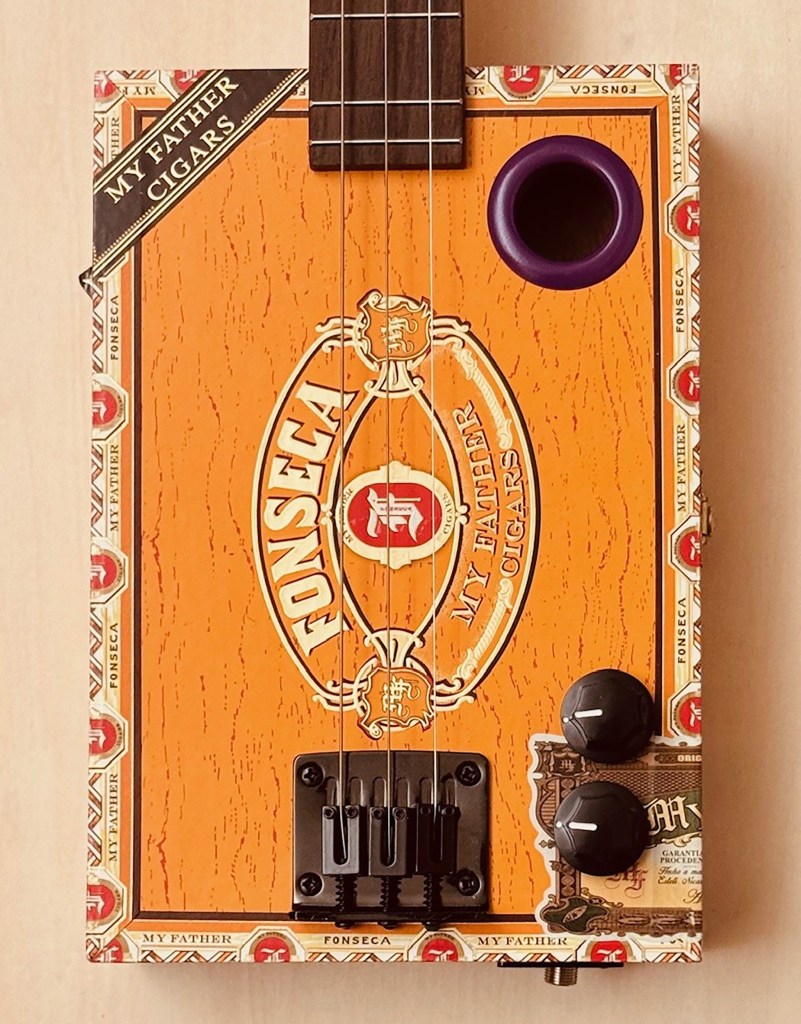
The only rule in building homemade instruments is there are no rules. That’s what makes it so fun.
“No one has ever chosen a cigar box instrument because it sounds like a Stradivarius. But… these ukuleles will start a conversation, and when people find they sound as good as most, and better than some commercial ukes, they’re amazed.”
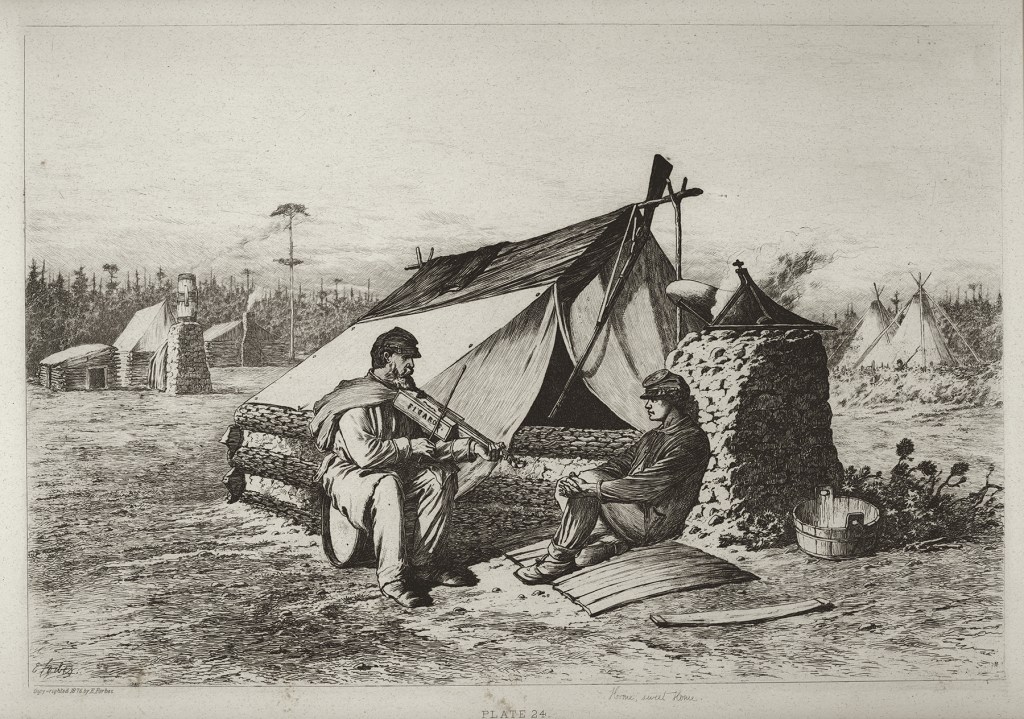
“Home Sweet Home” Edward Forbes 1876 copper plate engraving Union soldier playing a cigar box fiddle.
A Brief History of Cigar Box Instruments
As a goldsmith that has become a luthier, I create unique ukuleles and the occasional guitar using cigar boxes. While these instruments are crafted from discarded cigar boxes, and other recycled, repurposed or found materials, they are not a toy.
Cigar box instruments have a fascinating history in America. These homemade musical instruments, made from old cigar boxes and other recycled stuff, have captivated musicians and artists for over 150 years. They are a well-established form of American folk art.
Cigar box guitars trace their roots to the mid-1800s in the United States, during a time when musical instruments were luxuries that most people couldn’t afford.
Ingenious musicians and tinkerers began crafting banjos and guitars out of discarded cigar boxes. They used broom handles or staves for the neck, and strings were made from the wire used to bail cotton (bailing wire didn’t stretch, fence wire did), wire from screen doors or wire from worn-out brooms was also used. These homemade instruments were particularly popular in poor rural communities, especially in the Deep South, where blues and folk traditions thrived.
The cigar boxes themselves have an interesting history. Until the 1800s, cigars were typically sold in bundles wrapped in paper or other materials. However, as cigars became more popular, this sort of packaging made keeping track of inventory impossible, especially for taxation. Manufacturers started using boxes to package cigars in specified numbers 10, 20, 25, 50, and 100.
In 1863 the government mandated that cigars be sold in wooden boxes with tax stamps attached. These boxes featured intricate designs and branding to attract customers. Ingenious musicians and tinkerers began crafting guitars out of empty cigar boxes, broom handles, and wires salvaged from screen doors or windowpanes.
Cigar box instruments became especially prominent during the American Civil War. Using cigar boxes sent from home, soldiers would fashion guitars and fiddles from the materials available in camp. These instruments provided a source of entertainment and comfort during grim times
As economic times got better and guitars and ukuleles started to be mass produced, homemade instruments started to lose popularity and began to slide into history.
Fortunately, in recent decades cigar box guitars have seen a revival, thanks in part to the DIY and maker movements. Musicians and hobbyists alike craft their own instruments, and festivals celebrating cigar box guitar music have sprung up across the U.S. and beyond. Online communities and tutorials have made it easier than ever to build and play these distinctive instruments.
The thin Spanish cedar the cigar boxes are made from, has many qualities that make them ideal for making music. It has a very soft pleasant aroma, it is insect-repelling, is not affected by changes in humidity and, when carefully and lovingly built into an instrument will produce a warm, wonderfully romantic sound.
In the forests of Central America, Spanish cedar has been used for making instruments for a very long time, and to ensure Spanish cedar is sustainable, the cigar industry plants three replacement trees for each one that is harvested. For all the reasons it makes a very good cigar box, Spanish Cedar also makes a very resonant guitar, or cigar box ukulele.
I’m writing this as an artist who builds ukuleles and guitars from recycled, repurposed, and found materials, not as a music teacher. If you are looking for anything involving music theory, please enjoy the slideshow and check-out the music before going back to looking for your answers.
I‘m in my eighties. Over those years I’ve seen a lot and done a lot, and from it I’ve developed a personal life philosophy. “If it isn’t fun, don’t do it.”
One of the questions I often hear is,” is the ukulele easy to play?”
Yes, it is. It’s very easy. But that “yes” needs to be put in context.
If you’re near a ukulele, pick it up. With your thumb, strum down from top to bottom. Do this two or three times. Do the same from the bottom up. Please don’t think I’m trying to be a smart-alec, but you’re playing the ukulele. Very poorly, but you are playing. Getting better is easy.
For starts, a guitar has six strings, ukulele’s only have four, so that’s two less to keep track of. Because the uke only has four strings chord shapes are easy to learn. And best of all, hundreds, perhaps thousands of songs can be played within the first five frets.
To be fair, playing the ukulele is not all pie. There are disadvantages but all of them will be overcome within a couple of weeks.
The first is that odd tuning. Almost everyone’s familiar with the singsong My Dog Has Fleas as the sound of a ukulele. That strange tuning is called reentrant. All that means is the strings are not tuned in ascending or descending order, lowest to highest. Instead, one string breaks the chain and re-enters at a different position. Visualize four kids: ages six, four, three and two. Line them up stair-step style for a picture. Now move the six-year-old between the four and three-year old. The six-year-old has re-entered the order. That’s all reentrant is. For a week or two that darned “C”, that’s its name, will be in the way. It’s just not where your brain thinks it should be. I promise, once you understand what’s happening, and why, that C will be exactually where it belongs. That odd string placement is part of what makes the ukulele easy to play.
A second minor disadvantage are your fingertips. They’re tender, and for the first week or two they will get sore while practicing. Every time you press your fingertips against the strings it will irritate them, and in defense they will start building little calluses. As the calluses form the tenderness will go away.
Hands, particularly fingers, are marvelous appendages. They do amazing things without you even thinking about them. In our daily lives fingers have learned to work in concert. You can close your eyes and sign your name, and it will look just as it looks when you sign with your eyes open. That tight connection between your brain and your fingers is called muscle memory. For the first week or two old muscle memory will be a disadvantage but very quickly the new connections will be made.
Ukulele chord shapes are quite simple, but they require your fingers to work totally independently from each other, and at first, they won’t like it. You haven’t developed the connection between your brain and individual fingers yet. It doesn’t take very long to get your brain to talk to your fingers independently, but it will be frustrating at first. Be patient.
Words are powerful. They’re capable of evoking deep emotions. Take the word practice. That word brings up dreaded thoughts of hours doing scales. We need to change the way we see the word practice. At first practice should be in short periods. No more than ten minutes. The reason is that in the beginning, as the calluses are forming it won’t take more than ten minutes, pressing your fingertips against the strings until you’ll want to stop. So, stop. There’s nothing that says you can’t put in another ten minutes later. Your fingertips know when it’s time to go a few minutes longer.
Part of practice involves playing, and playing doesn’t necessarily mean practicing chords.
If your fingertips hurt, play with the ukulele. Hold it, turn it over and around, get used to how it feels. Without touching any frets, one at a time randomly finger-pluck the strings.
Just a short segue. The strings on stringed instruments are counted from the bottom up. The thumb plays the top string, number four. Your second finger has the C, number three. The middle finger plays the third string down, number two, and your ring finger of the left hand plays the bottom string, number one.
Let some of the notes ring short and some longer. You can, without playing any chords, plucking only one string at a time, changing only the timing between the notes, make very pleasant music. It won’t take a minute before you start looking to see where the note that would fit “there” next is. This is called “noodling” around and should become a habit. Fooling around with the ukulele is asking her to teach you what she can do. Give it a try. Noodling is the fast track to getting better.
What practice is, is teaching your fingers to learn new tasks. Ukulele chord shapes are very simple. With only two very easy chords and a half hour or so watching a video you will be able to play and sing along with Bob Marley’s Three Little Birds. You won’t be ready to go on stage, but you will be able to play a recognizable song. But first you need to learn how to overcome the temporary disconnection with individual fingers.
Here I would like to introduce Cynthia Lin. Not only is she a very good ukulele player, but she is also an outstanding ukulele teacher. If a picture is worth a thousand words, a close-up video patiently showing how to make those two chords is worth watching. In it, she goes into depth showing how to teach your brain to talk to one finger at a time so making chord shapes will be as natural as signing your name.
Now that you know a little about teaching your fingers new tricks it’s time to learn to play Three Little Birds.
In full disclosure, I do not know Ms. Lin. We have never met. There is no exchange of money or services any kind. Her videos are here because her teaching style is patient, clear, and non-intimidating toward a total beginner.
As an old guy, I no longer deal directly with the public. But I have a very nice gallery that showcases Santa Cruz area artists, and you can see cigar box instruments there. If you have any questions or comments about the instruments, feel free please use the form below.